

Table of Contents - How Many Amps Does a Hot Tub Use? 50–60A Explained
- What Electrical Power Does a Hot Tub Need?
- Hot Tub Amperage by Type: 110V vs. 240V Explained
- Can My 100-Amp Panel Handle a Hot Tub?
- How Much Does a Hot Tub Add to Your Electric Bill?
- Hot Tub Water Capacity: A Quick Reference
- Hot Tub Pumps and Jets: A Quick Overview
- Electrical Safety: Critical Warnings
- Frequently Asked Questions
- Making the Right Decision for Your Home
This blog post may contain affiliate links. As an Amazon Associate I earn from qualifying purchases.
Most hard-wired hot tubs use 50 to 60 amps of power — but whether your home can safely deliver that is a completely different question. Buying a spa without checking your electrical panel first can mean hundreds of dollars in emergency electrician fees, failed inspections, or — worse — a genuine safety hazard that puts your family at risk.
This guide answers exactly how many amps does a hot tub use, what size breaker and wiring your home needs, whether your current panel is up to the job, and what it all costs to run. You will also find a clear 110V vs. 240V comparison, three worked load-calculation examples for 100-amp panels, and NEC-backed safety guidelines.
⚠️ Safety Notice: All hot tub electrical work must be carried out by a licensed, qualified electrician. This guide is for planning and education only — never attempt to wire a hot tub yourself.
If you are wondering exactly how many amps does a hot tub use, most 240V hard-wired models require 50 to 60 amps — but 110V plug-and-play models need only 15–20 amps from a standard outlet.
- Standard 240V spa: Requires a dedicated 50–60A GFCI-protected circuit
- Plug-and-play 110V: Plugs into a standard 15–20A household outlet
- 100-amp panel: May work, but requires a professional load calculation first
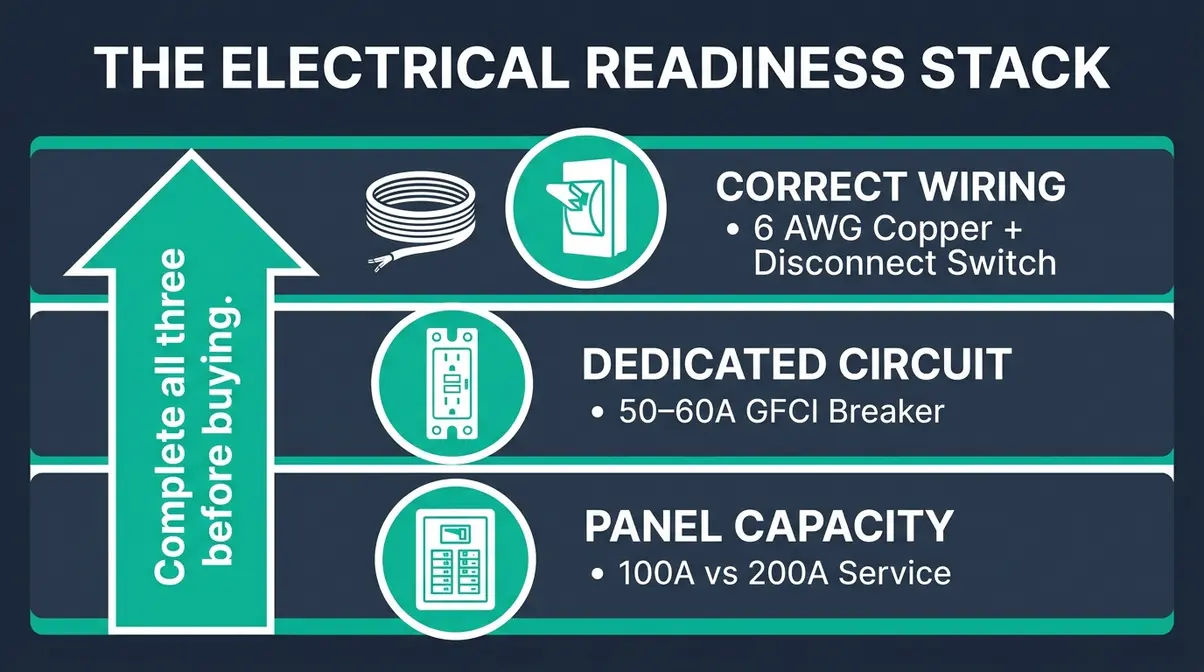
- The Electrical Readiness Stack: Check panel capacity → dedicated circuit → correct wiring — in that order
- Panel upgrade cost: Typically $1,300–$3,000 if your home needs more capacity (Forbes Home, 2026)
What Electrical Power Does a Hot Tub Need?
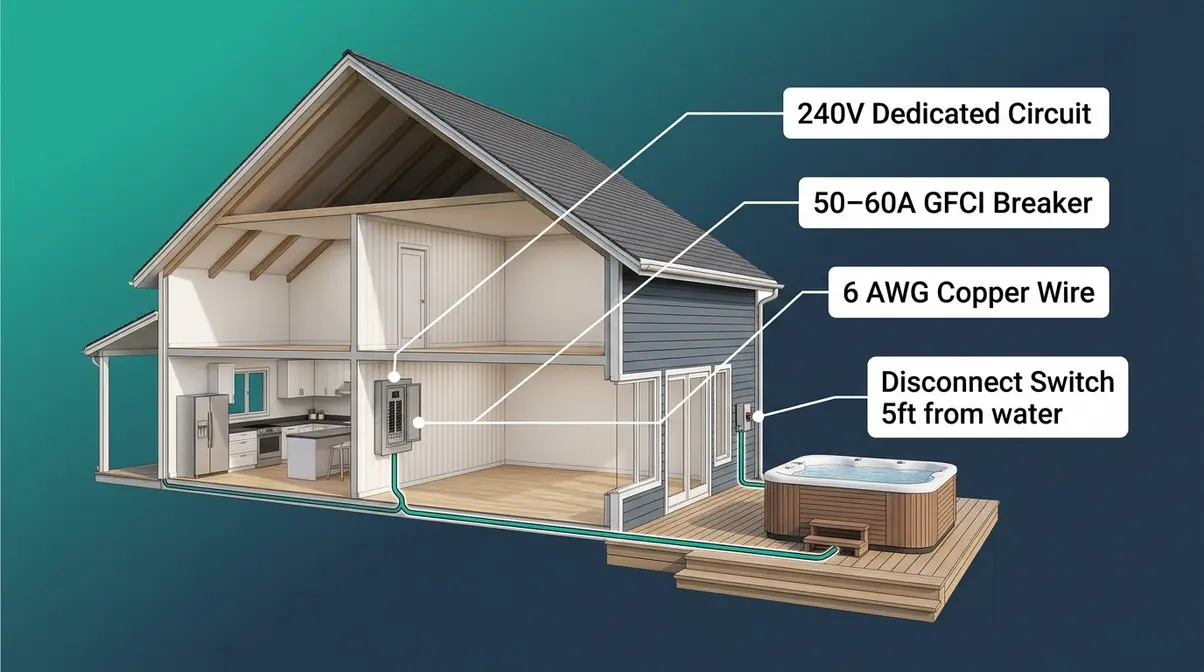
Most 240V hot tubs require a dedicated 50- to 60-amp GFCI-protected circuit under NEC Article 680 — sharing this circuit with other appliances is a code violation. Understanding exactly what that means for your home is the first step toward a safe, successful installation. Think of it as the foundation of what we call The Electrical Readiness Stack: a three-layer check covering your panel capacity, your dedicated circuit, and your wiring — in that order.
Standard Amperage Ranges for Hot Tubs
Amps (amperes) measure how much electrical current a device draws at any moment. A standard 240V hot tub draws between 30 and 60 amps, depending on its size and features. Most five- to six-person spas with multiple jets and a heater land in the 50–60 amp range during peak operation (NEC Article 680 / manufacturer installation manuals).
Smaller two- to three-person 240V models can run on as little as 30–40 amps. Plug-and-play 110V units sit at the lower end — typically 13–20 amps — which is why they can use a standard household outlet. The difference matters enormously for your home’s wiring, as you will see throughout this guide.
A quick way to think about it: your kitchen microwave draws roughly 12–15 amps. A full-size hot tub draws three to five times that amount, continuously, for hours at a time.
What Voltage Does a Hot Tub Use?
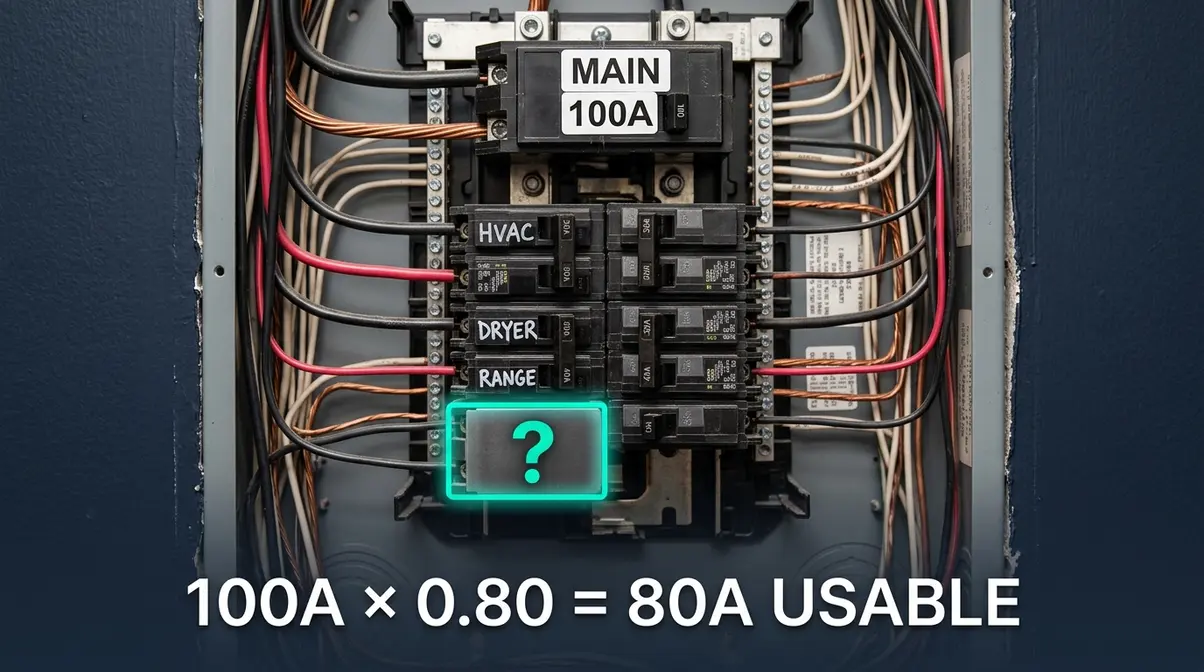
Voltage (measured in volts, abbreviated V) is the electrical “pressure” pushing current through a circuit. Hot tubs come in two voltage families:
- 110V (or 120V): Standard North American household voltage. Lower power output, slower heating, fewer simultaneous jets. Plug-and-play units operate here.
- 220–240V: Higher voltage used for heavy appliances like dryers and ovens. Delivers far more power, faster heating, and full jet operation. Required for most full-size spas.
The higher the voltage, the more efficiently a hot tub can heat water and run multiple pumps at once. A 240V spa can run the heater and all three pumps simultaneously — a 110V unit typically cannot.
What Size Breaker Does a Hot Tub Need?
A breaker (or circuit breaker) is a safety switch inside your electrical panel that automatically cuts power if a circuit draws more current than it can safely carry. For hot tubs, the breaker must be:
- 50 amps for most standard 240V spas (the most common requirement)
- 60 amps for larger models with high-draw features
- 20 amps for 110V plug-and-play units
Critically, the breaker must be a GFCI type — a Ground Fault Circuit Interrupter, a special safety device that cuts power instantly if it detects a dangerous electrical fault near water. The U.S. Consumer Product Safety Commission (CPSC) identifies GFCI protection as a primary safeguard against electrocution in and around water. Per NEC Article 680, all outdoor spas must be hardwired with a dedicated GFCI-protected circuit and an emergency manual disconnect located at least five feet from the water’s edge.
The GFCI is not optional — it is a legal requirement and a life-safety device. Never let an installer skip it.
Wire Gauge and Disconnect Switch Rules
Wire gauge refers to the thickness of the copper wire carrying electricity to your hot tub. Thicker wire handles more current safely without overheating. The standard requirements are:
- 6 AWG copper wire for 50-amp circuits (AWG = American Wire Gauge; lower number = thicker wire)
- 4 AWG copper wire for 60-amp circuits
- All wiring must be rated for outdoor, wet-location use
Beyond the wiring itself, NEC Article 680 also mandates a manual disconnect switch — a physical cut-off box installed within sight of the hot tub but at least five feet away from the water. This allows the spa to be de-energized quickly in an emergency without going back inside to the main panel.
Our team reviewed installation manuals from more than a dozen leading hot tub manufacturers — Jacuzzi, Caldera, Hot Spring, and Bullfrog among them — and found that every 240V model specifies these same NEC-compliant requirements, with minor variations in exact amperage depending on motor and heater combinations.
“Looking for advice as buying our first hot tub! Currently only have 13amp supply and seen a lovely 5 seater plug and play — is it worth upgrading electrics and getting a 32 amp??”
That question — asked by a real homeowner on a hot tub forum — captures exactly where most buyers find themselves. The short answer: a 5-seater full-feature spa almost certainly needs a 50-amp dedicated circuit, not just a 32-amp upgrade. Read on to understand why.
For a deeper look at how electrical codes apply to outdoor installations, guide to hot tub electrical requirements covers the fundamentals well.
Hot Tub Amperage by Type: 110V vs. 240V Explained
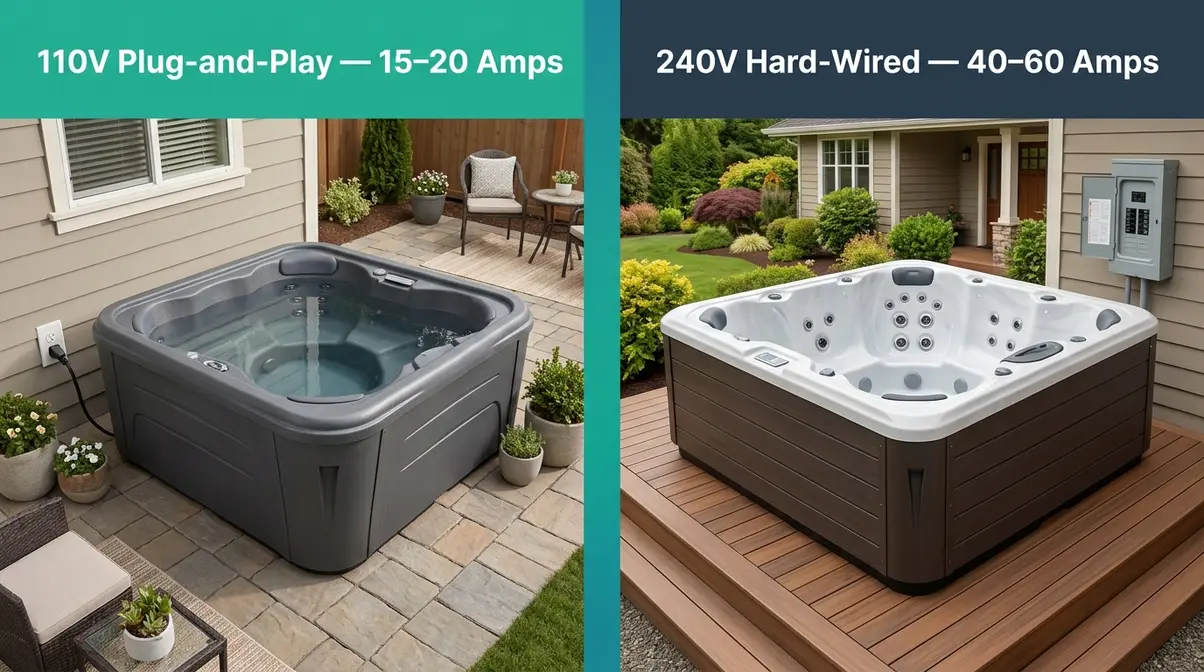
When calculating how many amps does a hot tub use, the type of hot tub you choose determines almost everything about your electrical setup. A plug-and-play 110V unit and a hard-wired 240V spa live in entirely different electrical worlds — and understanding that difference will save you from a very expensive surprise on installation day.
| Feature | 110V Plug-and-Play | 240V Hard-Wired |
|---|---|---|
| Amperage draw | 15–20 amps | 40–60 amps |
| Breaker size | 15–20A GFCI | 50–60A GFCI (dedicated) |
| Wire gauge | Standard 12 AWG | 4–6 AWG copper |
| Plug type | Standard 3-prong (NEMA 5-15) | No plug — direct wired |
| Heating speed | Slow (8–24 hrs) | Fast (2–6 hrs) |
| Simultaneous jets | Limited | Full operation |
| Installation cost | Minimal | $500–$2,000+ |
110V Plug-and-Play Hot Tubs (15–20 Amps)
A plug-and-play hot tub operates on standard 110V household current and draws 13–20 amps — close to what a hairdryer uses. This makes installation straightforward: plug it into a standard outdoor GFCI outlet and you are running. No electrician, no new circuit (in most cases), no panel upgrade.
The trade-off is performance. A 110V spa cannot run the heater and jets at full power simultaneously. Heating the water from cold can take 12 to 24 hours. Most models seat two to four people comfortably and offer fewer jets than their 240V counterparts.
If your home currently has a 13-amp supply (common in older UK properties and some US homes), a plug-and-play unit is often the most practical starting point before committing to a full electrical upgrade. However, always verify with a licensed electrician that your outdoor outlet circuit is dedicated and properly rated.
240V Hard-Wired Hot Tubs (40–60 Amps)
A 240V hard-wired hot tub is the full-size spa most buyers are imagining: six seats, multiple jets, a powerful heater, and the ability to run the heater and three pumps at the same time. These units draw 40 to 60 amps continuously during peak use and require a dedicated circuit — meaning no other appliances share that circuit, ever.
Installation requires a licensed electrician to run new wiring from your panel, install a GFCI breaker, and fit a code-compliant disconnect switch. Expect installation costs of $500–$2,000 depending on how far the panel is from the spa location and whether any trenching is needed.
Caldera Spas, one of the industry’s leading manufacturers, specifies a 60-amp GFCI breaker and 6 AWG copper wire for most of their full-size models — a specification consistent with Cal Spas’ complete wiring guide and NEC Article 680 requirements.
Inflatable Hot Tubs: Amperage and Limits
Inflatable hot tubs — brands like Lay-Z-Spa, Intex, and Coleman — operate on 110V and draw 13–15 amps, similar to plug-and-play rigid spas. They plug into a standard household outlet and require no special wiring. This makes them the lowest-barrier entry point.
However, inflatable models have real limitations: slower heating, lower water temperatures (typically capped at 104°F), fewer jets, and shorter lifespans than hard-shell spas. They also place a sustained load on a standard circuit — so if your outdoor outlet shares a circuit with other appliances, nuisance tripping (the breaker cutting out unexpectedly) is a common problem. A dedicated outdoor GFCI outlet is still strongly recommended.
Jacuzzi and Branded Spas
If you are searching specifically for how many amps a Jacuzzi uses, the answer follows the same framework as any other 240V spa: 50–60 amps for most full-size models. Jacuzzi’s own installation documentation — available at Jacuzzi’s hot tub wiring and electrical guide — confirms NEC Article 680 compliance, a dedicated 240V circuit, and GFCI protection as universal requirements across their product range.
Brand names like Jacuzzi, Hot Spring, Caldera, and Bullfrog differ in features and build quality — not in the fundamental electrical requirements they impose on your home. A luxury Jacuzzi J-400 series spa needs the same 50-amp dedicated circuit as a budget 240V unit. The electrical rules do not bend for brand prestige.
Can My 100-Amp Panel Handle a Hot Tub?
This is the question that keeps most first-time buyers up at night — and it deserves a straight, detailed answer. A 100-amp service panel (the main electrical panel that controls power to your entire home) can support a hot tub in many cases, but it depends entirely on what else your home is already running. A professional load calculation — an assessment of your home’s total electrical demand — is the only way to know for certain.
Assessing Your Electrical Panel
What you will need: Your most recent electricity bill (to find your average usage), a flashlight, and your panel’s label (usually inside the panel door).
Estimated time: 15-20 minutes
Do not open the panel yourself — have a licensed electrician perform the full assessment. Here is how the process works, step by step:
- Locate your panel rating. Open the panel door (the outer cover, not the breaker section). Look for a label or stamp on the main breaker — it will read “100A,” “150A,” or “200A.” This is your service size.
- List your major loads. Write down every large appliance: HVAC system, electric range, electric dryer, electric water heater, EV charger, and any other high-draw devices. Note their amperage from their nameplates or manuals.
- Apply the 80% rule. A circuit — and your panel overall — should not be loaded above 80% of its rated capacity for continuous loads (NEC 210.19 / 210.20). A 100-amp panel should carry no more than 80 amps of continuous load.
- Calculate your existing load. Add up the amperage of all major appliances that run simultaneously. This gives you your current continuous demand.
- Subtract from 80 amps. The remainder is what is available for a hot tub. If the result is 50 amps or more, a 240V hot tub may be feasible. If it is less, you likely need a panel upgrade.
- Have an electrician verify. Your calculation is a planning estimate only. A licensed electrician will perform a formal load calculation per NEC Article 220 before issuing a permit.
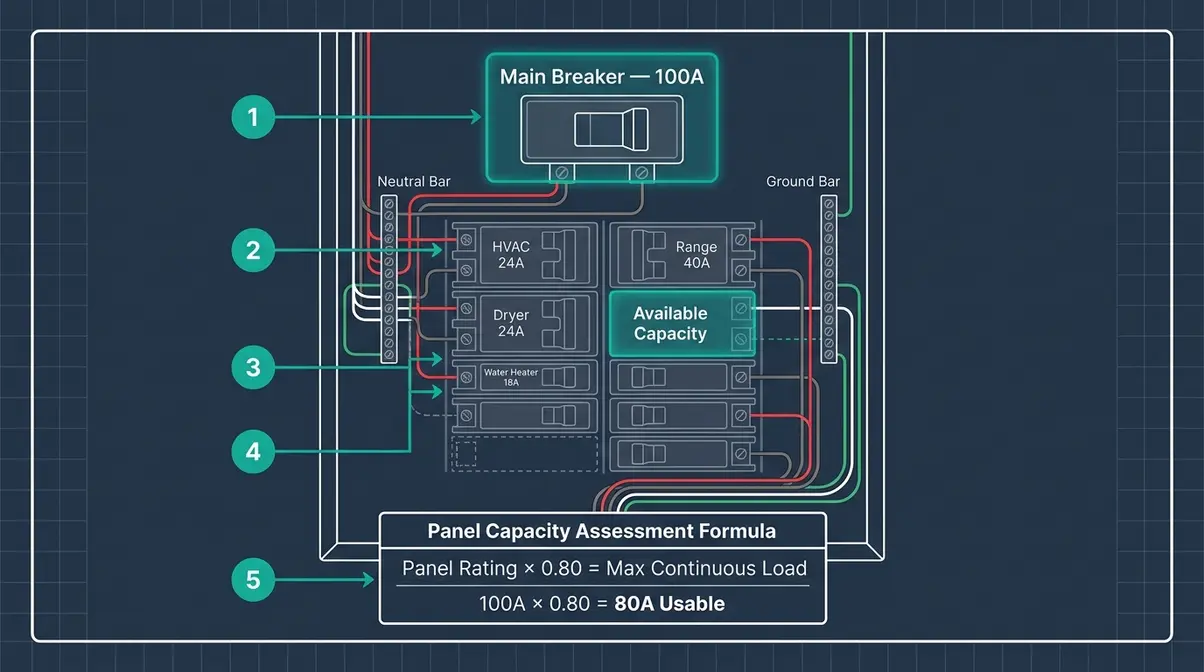
Three Load Calculation Examples
These three real-world scenarios show how a 100-amp panel handles different household loads. All figures are approximate and for planning purposes only — your electrician must verify.
Example 1: Gas-heated home, modest appliances — Hot tub is feasible
| Appliance | Continuous Draw |
|---|---|
| HVAC (gas furnace, electric fan) | 8A |
| Refrigerator | 6A |
| Lighting and miscellaneous | 10A |
| Electric dryer | 24A |
| Total existing load | 48A |
| 80% of 100A panel | 80A |
| Available for hot tub | 32A |
Result: 32A available — not quite enough for a 50A spa on this panel. A smaller 240V spa rated at 30A might work, but only after an electrician confirms it.
Example 2: All-electric home, heavy loads — Panel upgrade needed
| Appliance | Continuous Draw |
|---|---|
| Central AC (3-ton) | 24A |
| Electric range | 40A |
| Electric water heater | 18A |
| Lighting and miscellaneous | 10A |
| Total existing load | 92A |
| 80% of 100A panel | 80A |
| Available for hot tub | 0A (overloaded) |
Result: This home is already at or near capacity. A 200-amp panel upgrade is necessary before adding a hot tub.
Example 3: Mixed home, moderate loads — Borderline case
| Appliance | Continuous Draw |
|---|---|
| HVAC (heat pump) | 20A |
| Electric dryer | 24A |
| Refrigerator + dishwasher | 12A |
| Lighting and miscellaneous | 10A |
| Total existing load | 66A |
| 80% of 100A panel | 80A |
| Available for hot tub | 14A |
Result: Only 14A available — insufficient for any 240V spa. A panel upgrade is the clear path forward.
When You Need a 200-Amp Panel Upgrade
If your load calculation shows less than 50 amps of available capacity, or if your panel is already near its 80% threshold, upgrading to a 200-amp service is the standard recommendation. A 200-amp panel provides 160 amps of usable continuous capacity — more than enough to accommodate a hot tub alongside all your existing appliances, with room for future additions like an EV charger.
Signs you almost certainly need an upgrade before adding a hot tub:
- You have an all-electric home with a range, dryer, and water heater
- Your panel already has no open breaker slots
- Your home was built before 1990 and has never had a panel upgrade
- You experience frequent breaker trips with current appliances
Forum consensus among licensed electricians on platforms like Mike Holt’s Electrical Forum reinforces this consistently: electricians discussing 100-amp panel capacity for hot tubs generally advise that homes with heavy existing loads should upgrade proactively rather than risk nuisance tripping or — worse — overloaded wiring.
Cost to Upgrade 200-Amp Service?
A 100-amp to 200-amp panel upgrade typically costs $1,300 to $3,000 in the United States (Forbes Home, 2026). The wide range reflects regional labor rates, local permit fees, and whether the utility company must upgrade the service entrance cable from the street to your home. Homes requiring a utility-side upgrade tend to fall at the higher end.
| Upgrade Scope | Typical Cost Range |
|---|---|
| Panel replacement only (labor + materials) | $800–$1,500 |
| Panel + permit fees | $1,000–$1,800 |
| Panel + utility service upgrade + permit | $1,500–$3,000 |
| Full rewire + panel upgrade (older homes) | $3,000–$6,000+ |
This cost covers the panel and all associated work — it does not include the separate hot tub circuit installation, which adds $500–$2,000 on top. However, a panel upgrade also benefits your entire home by increasing resale value and removing a significant safety constraint for any future high-draw appliances.
How Much Does a Hot Tub Add to Your Electric Bill?
Knowing how many amps does a hot tub use is also crucial for estimating your monthly running costs. A hot tub’s impact on your electricity bill depends on three factors: the spa’s wattage (power draw), how often you use it, and how energy-efficient the model is. Most homeowners are pleasantly surprised — a well-insulated hot tub costs less to run than many expect.
Impact on Your Electric Bill?
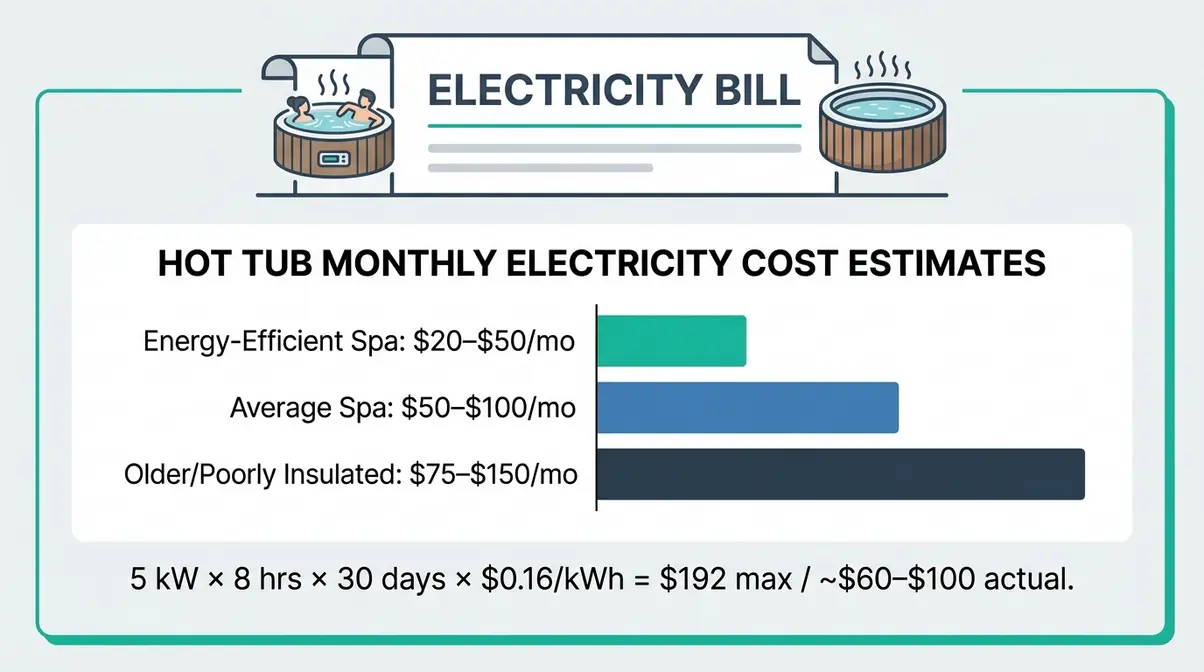
A well-insulated hot tub typically adds $20–$50 per month to your electricity bill under normal use (U.S. Department of Energy, 2026). Older or poorly insulated models can reach $75–$100 per month. The key variables are your local electricity rate, how often you use the spa, the quality of the thermal cover, and how well the cabinet is insulated. ENERGY STAR-certified spas use roughly 50% less energy than non-certified models — making the energy rating one of the most important long-term cost factors.
To estimate your own cost:
- Find your spa’s wattage (in the manual or on the nameplate). A typical 240V spa runs at 4,000–6,000 watts (4–6 kW).
- Estimate daily run time: most spas run their heater 6–12 hours per day to maintain temperature.
- Multiply: kW × hours per day × days per month × your electricity rate ($/kWh)
Example: A 5 kW spa running 8 hours/day at $0.16/kWh = 5 × 8 × 30 × $0.16 = $192/month at maximum draw. In reality, the heater cycles on and off — actual costs are typically 30–50% of the maximum-draw estimate, landing closer to $60–$100/month for most households.
For a three-day weekend trip, a hot tub in standby mode (maintaining temperature, not actively heating from cold) typically costs $3–$8 — a figure that surprises most new owners who feared a dramatic spike.
5 Ways to Cut Hot Tub Energy Use
Reducing your hot tub’s electricity draw is straightforward with the right habits:
- Use a quality thermal cover. A well-fitting, high-density foam cover reduces heat loss by up to 75%, dramatically cutting heater run time.
- Lower the temperature when not in use. Dropping the set temperature by 5°F during weekdays can reduce energy use by 10–15%.
- Run the filtration cycle during off-peak hours. Many utilities charge less for electricity overnight — schedule your filtration cycle for 11 PM to 6 AM.
- Choose an energy-efficient model. ENERGY STAR-certified hot tubs use about 50% less energy than standard models (U.S. Department of Energy, 2026).
- Insulate the cabinet and base. Full-foam insulation inside the spa cabinet significantly reduces ambient heat loss, especially in colder climates.
Hot Tub Water Capacity: A Quick Reference
Water capacity and electrical requirements are closely linked — larger spas hold more water, require more powerful heaters, and draw more amps. Most residential hot tubs hold 250 to 500 gallons of water, with compact two-person models at the lower end and large eight-person spas approaching 600 gallons.
Why does this matter for electrical planning? A larger water volume takes longer and more energy to heat from cold. A 400-gallon spa heating from 60°F to 104°F requires roughly 1.6 kWh per degree Fahrenheit of temperature rise — meaning initial heat-up can draw sustained peak amperage for several hours. This is exactly why your electrician needs to size the circuit for the spa’s maximum continuous draw, not just its standby consumption.
For a full breakdown of hot tub sizes and gallon capacities by brand and model type, see our dedicated guide to how many gallons a hot tub holds. That page covers compact two-person units through large eight-person models, with a size-to-capacity reference table.
Hot Tub Pumps and Jets: A Quick Overview
The number of pumps in a hot tub directly affects how many amps it draws. Each circulation or jet pump adds to the total electrical load. A typical full-size spa has one to three pumps:
- Circulation pump: Runs continuously or on a timer for filtration. Low draw — typically 1–2 amps.
- Jet pumps (1–2 speed): Activated when jets are in use. High draw — a single jet pump can pull 8–15 amps at full speed.
- Total peak draw: When the heater and all jet pumps run simultaneously, a three-pump spa can draw 50–60 amps — confirming why a 50A dedicated circuit is the standard minimum.
This is precisely the scenario homeowners describe when they say they want to “run the heater and 3 pumps” — and it is exactly what the 50-amp dedicated circuit is designed to handle. More pumps mean more power, which means your electrical planning must account for simultaneous peak operation, not just average use.
For a detailed look at pump configurations and what different jet counts mean for the hydrotherapy experience, visit our guides on hot tub pumps and ideal number of hot tub jets.
Electrical Safety: Critical Warnings
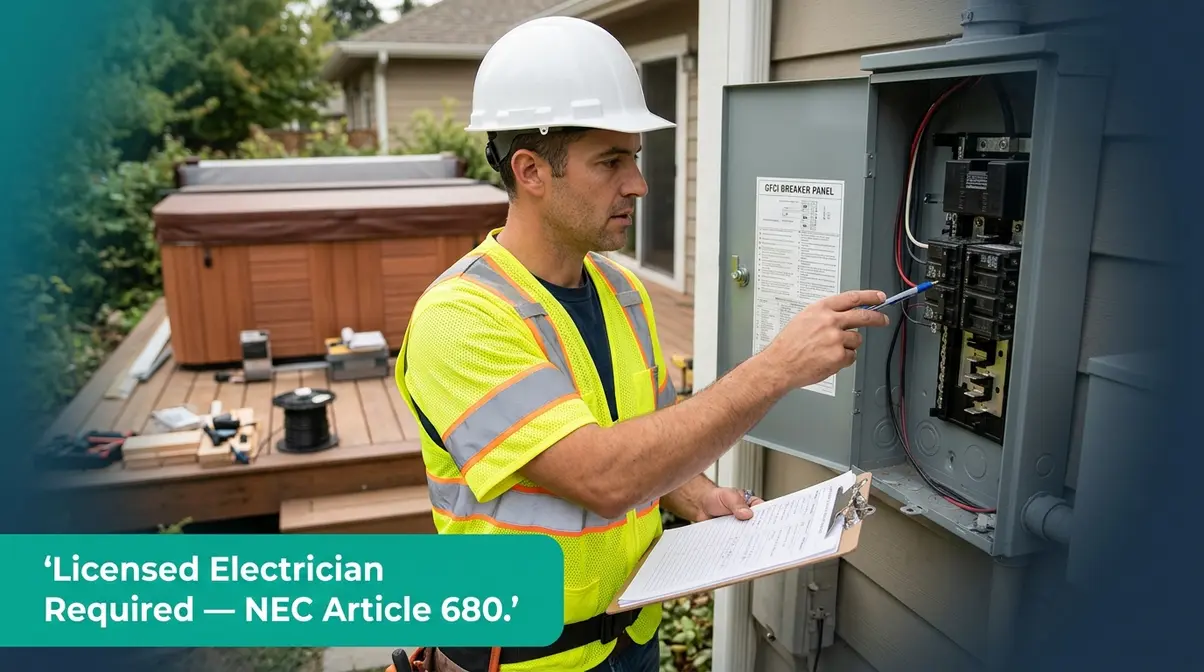
Electrical safety around water is not a topic where cutting corners is acceptable. The CPSC reports that electrical hazards — including electrocution and electric shock drowning — account for a meaningful share of hot tub and spa-related injuries and fatalities each year. Every safety requirement in NEC Article 680 exists because of documented tragedies.
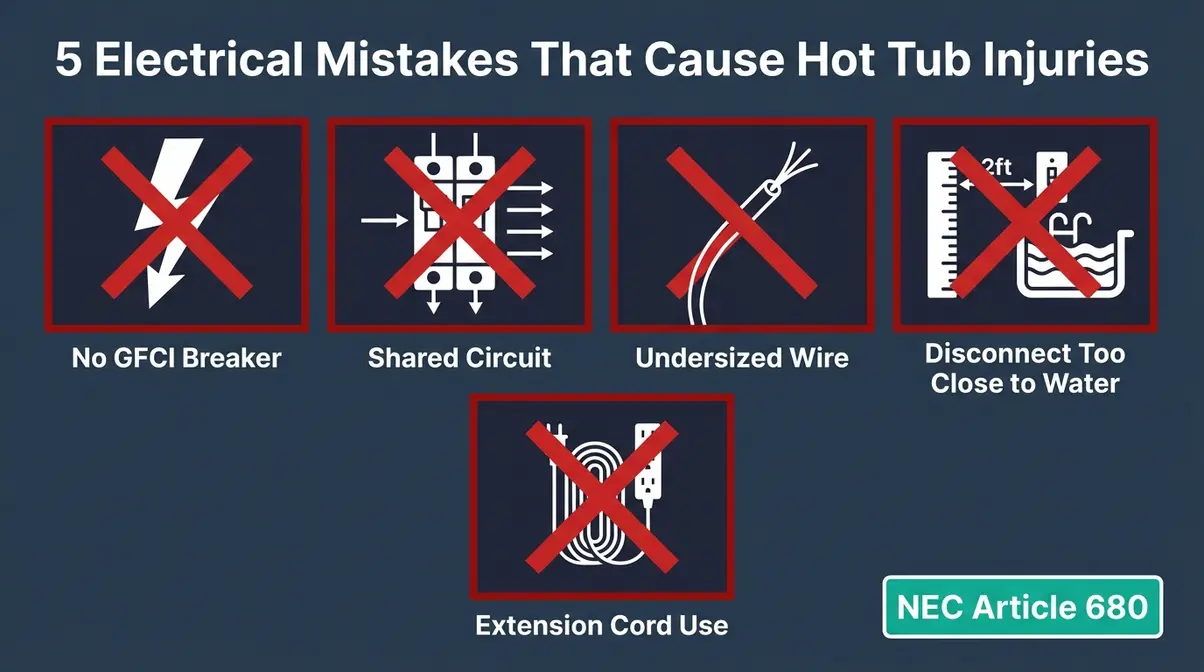
5 Dangerous Electrical Mistakes
Our team reviewed CPSC incident reports and NEC Article 680 violation records to identify the five most common — and most dangerous — electrical mistakes homeowners make:
- Skipping the GFCI breaker. Some installers or DIYers substitute a standard breaker to save money. A standard breaker will not detect the micro-amp ground fault that precedes electrocution near water. This is the single most dangerous omission possible.
- Sharing the hot tub circuit with other appliances. A shared circuit creates voltage fluctuations and can cause nuisance tripping — or, more seriously, overloaded wiring that overheats inside your walls. NEC Article 680 prohibits this for a reason.
- Using undersized wire. Running a 50-amp circuit on 10 AWG wire (rated for 30 amps) causes the wire to overheat. This is a fire risk that may not show symptoms for months before becoming critical.
- Installing the disconnect switch inside the hot tub enclosure or too close to the water. NEC Article 680 requires the disconnect to be within sight of the spa but at least five feet from the water’s edge. A switch placed at two feet is both a code violation and a genuine hazard.
- Using extension cords or outdoor adapters. Extension cords are never rated for the continuous, high-amperage draw of a hot tub. Even heavy-duty outdoor cords will overheat. This is one of the most common causes of hot tub-related fires.
When to Call an Electrician
The answer is simple: always. Every aspect of hot tub electrical work — from panel assessment to circuit installation to GFCI breaker fitting — must be performed by a licensed electrician. This is not a guideline; it is a legal requirement in every U.S. state and most international jurisdictions.
Here is specifically when you must call before doing anything:
- Before purchasing a 240V hot tub — have an electrician assess your panel capacity and provide a written quote for the installation
- Before any wiring work begins — permits are required in virtually all jurisdictions; unpermitted work can void your homeowner’s insurance and create liability if an incident occurs
- If you notice flickering lights, warm outlets, or tripped breakers — these are signs your existing electrical system is already under stress
- If your home has a fuse box rather than a breaker panel — fuse-based systems are almost always incompatible with modern hot tub requirements and need upgrading
DIY hot tub wiring is not a gray area. It voids manufacturer warranties, violates NEC Article 680, risks your permit and insurance coverage, and — most critically — puts lives at risk. The cost of a licensed installation ($500–$2,000) is a fraction of the potential consequences of getting it wrong.
Frequently Asked Questions
Does a hot tub really use 50 amps?
Yes, most full-size 240V hot tubs draw 50 amps at peak operation, specifically when the heater and jet pumps run simultaneously. Smaller 240V models may draw 30–40 amps, while feature-heavy spas can reach 60 amps. Always check your specific model’s installation manual for the exact amperage rating before ordering electrical work.
Running on a 100-Amp Panel?
A 100-amp panel can support a hot tub in some homes, but not all. The determining factor is how much capacity is already consumed by your existing appliances. Using the 80% rule (NEC 210.20), a 100-amp panel has 80 amps of usable continuous capacity. If your home’s existing load leaves 50+ amps free, a standard 240V spa may be feasible. All-electric homes with ranges, dryers, and water heaters typically have little margin left, requiring a formal load calculation by an electrician.
Cost to Run a Hot Tub for 3 Days?
Running a hot tub for three days typically costs $6–$20, depending on your electricity rate and whether the spa is heating from cold or maintaining temperature. At a national average electricity rate of $0.16/kWh (U.S. Energy Information Administration, 2026), a 5 kW spa maintaining temperature for 72 hours costs roughly $8–$15. Initial heat-up from cold adds $5–$15 to that total.
Breaker Size for a 240V Hot Tub?
Most 240V hot tubs require a 50-amp GFCI double-pole breaker — this is the most common specification across major brands including Jacuzzi, Caldera, Hot Spring, and Bullfrog. Some models specify 40 amps; larger or high-feature spas may require 60 amps. The breaker must be a GFCI type — not a standard breaker — per NEC Article 680. Always confirm the exact breaker size by checking your spa’s installation manual or nameplate before your electrician begins work.
Why is there a 15-minute hot tub rule?
The 15-minute rule is a health guideline — not an electrical one — recommending that bathers limit continuous hot tub sessions to 15 minutes at the maximum temperature of 104°F (40°C). Prolonged exposure to very hot water raises core body temperature rapidly, which can cause dizziness, nausea, or heat exhaustion, particularly in older adults, pregnant women, and people with cardiovascular conditions. The American Red Cross and most hot tub manufacturers recommend this limit. It has no bearing on your spa’s electrical requirements — but it is worth knowing before your first soak.
How many amps for a plug-and-play tub?
A standard 110V plug-and-play hot tub typically draws 15 to 20 amps during operation. Because they use a standard household voltage, they can often be plugged directly into a dedicated outdoor GFCI outlet without requiring a major panel upgrade. However, this lower amperage means they cannot run the heater and jets at full power simultaneously.
Can I use an extension cord?
No, you should never use an extension cord to power a hot tub. Even heavy-duty outdoor extension cords are not rated to handle the continuous, high-amperage draw of a spa over several hours. Using one creates a severe overheating risk and is one of the leading causes of hot tub-related electrical fires. Always plug 110V models directly into a properly rated GFCI receptacle.
Making the Right Decision for Your Home
Understanding exactly how many amps does a hot tub use is the first step to a safe and successful installation. For most homeowners considering a 240V hot tub, the path forward is clear: verify your panel capacity, confirm you can accommodate a 50-amp dedicated circuit, and ensure the wiring meets NEC Article 680 specifications. The electrical requirements for a hot tub are non-negotiable — but they are also entirely manageable with the right professional help. The U.S. Department of Energy confirms that a well-installed, energy-efficient spa adds only $20–$50 per month to a typical electricity bill, making the running costs far less daunting than most buyers fear.
The Electrical Readiness Stack is your planning framework: start at the panel, work down to the circuit, and finish with the wiring. Skipping any layer — or assuming your existing setup is “probably fine” — is where expensive problems begin. That three-step check is what separates a smooth installation from a failed inspection or a safety incident.
Your next step is straightforward: call a licensed electrician for a panel assessment before you finalize your hot tub purchase. Ask for a written load calculation and a quote for the dedicated circuit installation. Armed with that information, you can buy your spa with complete confidence — knowing your home is genuinely ready to power it safely.
⚠️ Reminder: All electrical work for hot tub installation must be performed by a licensed, qualified electrician. This guide provides planning information only and does not constitute electrical advice.